Posted: Thursday 6 October 2011
-
3 comment(s)
[ Comment ]
-
0 trackback(s)
[ Trackback ]
I enjoyed a visit to The Highland Folk Museum in Newtonmore with my sister and my nephews at the weekend. The boys love the Museum, which is a real hands on experience and they visit on a regular basis. It's an amazing place with so much on offer for children and adults alike to learn about the lives and work of our ancestors. The site portrays aspects of 200 years of Highland rural and social life starting with the early 1700s and ending with the mid 1900s. This fascinating living history site provides an interesting and varied landscape incorporating farmland, woodland and open areas. There are a number of relocated and recreated community and workplace buildings and features worth exploring including The Railway Halt, Glenlivet Post Office, Shepherd's bothy and fank, Knockbain School, Leanach Church (early 1900s corrugated tin church relocated to the Museum from Culloden), Macpherson's Tailor's Shop, Clockmaker's Workshop and Bow Tent (traditional travellers' tent). My personal favourite and I think an exceptional feature of the Museum is the recreation of part of the Highland ‘township’ of Easter Raitts. The original site is located well up the Spey Valley side to the north of Lynchat, near Kingussie and although there are prehistoric remains at the site, the principal township settlement dates from the later Medieval period through to the early 1800s. The township is an impressive sight as it comes into view on the hill as you approach it from the pinewoods. I love the smell of the burning peat fires which are lit by experienced costumed staff who are on hand to give you an insight into how the people of the township lived and worked all those years ago. 
The Pinewoods, an early 1900s plantation on top of what once was a very hilly ladies golf course, provide a habitat for a variety of birds and animals including tree creepers and red squirrels. We were delighted to spot a red squirrel who stopped for a snack before treating us to an acrobatic display as he jumped nimbly from tree to tree. 
What makes this Museum even more special for me and my family is that after World War II my late Granpa, Robert Kirk, took over the farmhouse and steading and worked the farm until it was acquired for the Museum in 1987. "Aultlarie" is the original name for both the farm and the adjacent stream, probably coming from the Gaelic "Allt Làirigh" meaning "Burn of the Gorge". My siblings and I have many happy memories, of times when we were young, spent exploring the farm, feeding the animals, helping with the harvest and generally enjoying a carefree existence. The Highland Folk Museum is keeping our heritage alive and I would thoroughly recommend a visit. It's a great day out for all the family and at the time of writing this blog post entry is FREE  (although I would suggest giving a generous donation on leaving. There is a donation container near the entrance). (although I would suggest giving a generous donation on leaving. There is a donation container near the entrance).
|
Posted: Monday 26 September 2011
-
4 comment(s)
[ Comment ]
-
0 trackback(s)
[ Trackback ]
Scotland has some of the most spectacular lochs in the world, over 31,000 freshwater lochs, though only around 350 of any significant size. The country is also fringed with mighty sea lochs, or fjords. The vast majority of both are in the north and west, but you need not venture far in any direction to come face to face with a scenic stretch of water. The magical waters of Scotland's lochs are always surrounded by breathtaking scenery. Here's a few of my favourites. Loch Fyne in Argyll and Bute is the longest and deepest of Scotland's many sea lochs. It was formed after the last glaciation in Scotland around 10,000 years ago. It is famous for the delicious oysters it produces which are grown naturally, on the shore at Ardkinglas at the head of the loch, and are exported as far afield as Hong Kong and Cape Town. Mussels and shellfish can also be found in the waters of Loch Fyne. A visit to the acclaimed Loch Fyne Oyster Bar and Shop is the perfect treat for any food lover with an abundance of gourmet food on offer. More oysters are sold here than anywhere else in the country. So if you happen to be in the area give it a try. 
Situated in the very heart of Scotland, Perthshire is an area of gentle glens, rolling hills, rugged mountains, tranquil lochs, mature woodland, roaring rivers and fertile farmland. Loch Rannoch lies in this wild and unspoilt countryside, surrounded by spectacular mountain scenery. The loch runs for ten miles and offers excellent fishing opportunities in a truly magnificent setting. Walkers will enjoy exploring the Tay Forest Park which lies on the south shore and is home to remnants of the ancient Caledonian Forest. An ancient crannog can be found at the western end of the loch. Crannogs are artificial islands found throughout Scotland and Ireland dating from 5,000 years ago. They represented symbols of prosperity and power. These ancient defensive loch-dwellings were inhabited by families or tribes and provided protection from all sorts of danger. 
Loch Duich is a sea loch situated on the west coast. Surrounded by steep imposing mountains and heather-clad moorland this is an area of outstanding natural beauty and peacefulness personified. Bealach Ratagain or Mam Ratagan Pass at 1100ft is on the route from Shiel Bridge, at the head of Loch Duich, to the remote crofting area of Glenelg. The road climbs steeply until you reach the viewpoint where you are met with breathtaking views over the impressive Five Sisters of Kintail mountain ridge and down to the boot-shaped inlet of Loch Duich. The high ridge, rising sharply from Glen Shiel, runs for some five miles and reaches a maximum height of 3501ft. It is the most popular destination for hill walkers in the area, encompassing three Munros. According to legend 2 Irish princes arrived in Kintail and married 2 daughters of the local chief. They promised to return with their 5 brothers who would then marry the 5 remaining daughters. However, they never returned and the sad sisters were turned into these lovely mountains to maintain their beauty while they kept their sad vigil. 
Loch Insh, situated in the heart of Badenoch and Strathspey in the Highlands, has a spectacular scenic setting amidst woodland and mountains. It's a watersports centre offering tuition and courses in canoeing, windsurfing and sailing. In recent years the surrounding woodland areas have been developed to provide adventure playgrounds, nature trails, wildlife lookouts and a small pond for fishing. You can even have a go at dry slope ski-ing, raft building and archery. The Boathouse Restaurant which overlooks the loch provides wonderful views. 
Argyll and Bute is an area of outstanding natural beauty, rich in history and heritage, boasting a spectacular array of scenery from its string of offshore islands forming part of the Inner Hebrides to lush subtropical gardens warmed by the Gulf Stream, from remote peninsulas to deserted golden beaches, from magnificent mountain peaks to scenic harbour villages. There's something for everyone around here - coastal walks, nature and bird-watching, the full range of water-based activities, mesmerising and magical prehistoric sites, battle scarred castles and breathtaking views around every corner. Loch Melfort is definitely one of my favourite lochs in this part of Scotland. 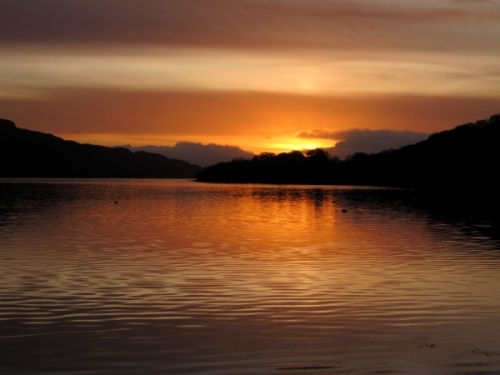
Loch Aye the Noo Part 2 coming soon 
|
Posted: Wednesday 21 September 2011
-
3 comment(s)
[ Comment ]
-
0 trackback(s)
[ Trackback ]
With the onset of Autumn - lots of rain today and cooler temperatures - I decided to look through my photos of a fantastic trip I made to the Western Isles with friends several summers ago. We had unbroken sunshine for the entire two weeks that we spent island hopping. It was one of my best holidays ever. Now, in my humble opinion, I think the Western Isles has some of the best beaches in the world . Here's a few of my favourites. Harris has a wide range of terrains from wild rugged mountains and breathtaking sandy beaches, bordered by colourful machair, to imitation lunar landscapes peppered with ancient rocks, some dating back millions of years. The landscape of Harris has a unique charm and unspoilt beauty and exploring this stunning island is a truly rewarding experience. Horgabost beach is one of the most beautiful beaches on the west coast. The golden sands, turquoise sea and foaming breakers with the backdrop of fertile rolling hills created a visually stunning scene. We were spoilt for choice as we encountered so many spectacular beaches on our travels but this view of Horgabost was most definitely one of our favourites. 
The magnificent Luskentyre beach lies on the west side of South Harris. With its vast expanse of golden sands, which seem to stretch as far as the eye can see, and the backdrop of the hills of the north the location of this beach is quite spectacular. Its remoteness ensures that you are always guaranteed to miss the crowds whenever you are visiting. In fact on the day we were there we only met four other people. 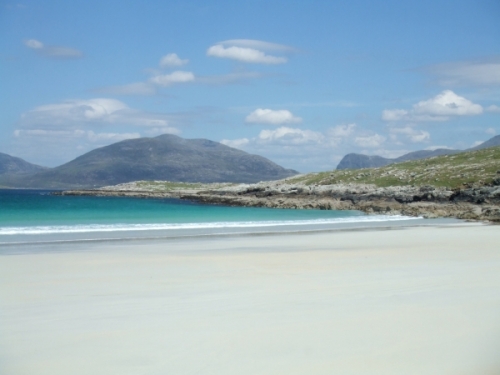
The low-lying Isle of Berneray is situated between Harris and North Uist in the Western Isles. The island is home to just over 100 people and is about two miles by three miles. Berneray is famous for its long, isolated sandy beaches backed by high dunes and machair. We weren't disappointed when we set our eyes and feet on the beautiful white sands. We found the local community friendly and helpful, but most of all they were passionate about their inspiring wee island and were keen to share their stories with us. 
The Isle of Eriskay lies between South Uist and Barra in the Western Isles and is connected to South Uist by a causeway. Although only measuring two miles by one mile Eriskay is big on historical headlines. The island's main beach on the west coast is where Bonnie Prince Charlie landed on Scottish soil in 1745 and took shelter in a local blackhouse. The inspiration for Compton MacKenzie's "Whisky Galore" was sparked by the story of the SS Politician, bound for Jamaica, which sank off shore in 1941 releasing, among its cargo, 264,000 bottles of whisky. The islanders were in their element as they salvaged the bottles because due to war-time rationing the island had run "dry". We hung out on the beach below while we waited for the ferry to Barra, making it probably one of the world's most scenic "waiting rooms". 
Vatersay is the western most permanently inhabited place in Scotland. Linked to Barra by a causeway which was completed in 1991, it is approximately three miles by three miles but incredibly it boasts two of the most spectacular beaches in the whole of the Western Isles. The "Bonnie Prince Charlie Flower", thought to originate from the French seeds dropped by the Prince, grows here among the machair. Vatersay has a unique charm and gentle character and once you have stepped onto its shores it is extremely difficult to leave. You could mistake the photo below for a tropical beach scene but I can assure you that on dipping your toe in the water you would soon realise you were in Scotland...freezing! 
Well, I enjoyed that wee reminisce. It's certainly cheered me up  on a rather gloomy September day. on a rather gloomy September day.
|
Posted: Monday 5 September 2011
-
2 comment(s)
[ Comment ]
-
0 trackback(s)
[ Trackback ]
What a great day I had on Sunday at Jupiter Artland - www.jupiterartland.org. The sun was shining  and it was one of the best days of the year so far, weatherwise! This incredible place is a contemporary sculpture garden in the private grounds of the magnificent Jacobean manor house, Bonnington House, a short distance from Edinburgh. Owned by Robert and Nicky Wilson Jupiter Artland displays works by many of today's leading artists, sculptors and land artists. These artworks have been commissioned and are then constructed in situ to create a thought-provoking journey through beautiful woodland just skirting the edge of the West Lothian countryside. and it was one of the best days of the year so far, weatherwise! This incredible place is a contemporary sculpture garden in the private grounds of the magnificent Jacobean manor house, Bonnington House, a short distance from Edinburgh. Owned by Robert and Nicky Wilson Jupiter Artland displays works by many of today's leading artists, sculptors and land artists. These artworks have been commissioned and are then constructed in situ to create a thought-provoking journey through beautiful woodland just skirting the edge of the West Lothian countryside. 
The sculpture garden allows you to experience art on a grand scale and at the same time appreciate the art within the landscape. We were very fortunate to be shown around by Nicky who has an undeniable enthusiasm and passion for the place. Listening to her description of the art and her explanations of how the concepts were created was fascinating and certainly brought the sculptures to life as well as giving greater meaning to the whole experience. 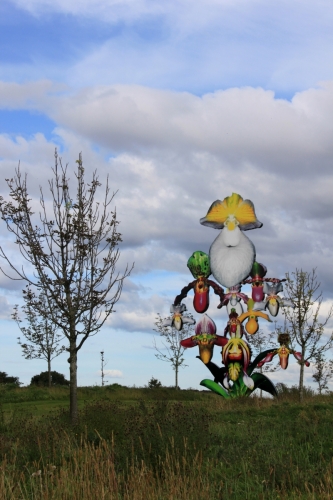
You can spend as little or as long as you like walking around the artworks. There is no definite direction so you can suit yourself as to which exhibits you want to look at first. A map is provided so it's easy to locate each piece of art within the grounds. After you've enjoyed exploring the art you can visit The Jupiter Artland Cafe and indulge yourself in some delicious home baking and artisan roast coffee served from the fabulous silver streak caravan situated within the steadings of the park. A selction of freshly prepared light meals are also available. Don't forget to check out the shop too. 
A great place for young and old alike .
|
Posted: Wednesday 24 August 2011
-
1 comment(s)
[ Comment ]
-
0 trackback(s)
[ Trackback ]
One of my best friends was married  recently in the former spa resort of Strathpeffer in Ross and Cromarty. What a great day we all had celebrating with Alison & John. The bride looked radiant, the groom oozed charm and the sun shone on us all . In the Victorian era Strathpeffer was popular as a spa resort, due to the discovery of sulphurous springs in the 18th century. The village is largely unspoilt and is a visual feast for the visitor in terms of Victorian architecture. The pump-room in the middle of the village dates from 1819. Soon after that, a hospital and a hotel were also built. recently in the former spa resort of Strathpeffer in Ross and Cromarty. What a great day we all had celebrating with Alison & John. The bride looked radiant, the groom oozed charm and the sun shone on us all . In the Victorian era Strathpeffer was popular as a spa resort, due to the discovery of sulphurous springs in the 18th century. The village is largely unspoilt and is a visual feast for the visitor in terms of Victorian architecture. The pump-room in the middle of the village dates from 1819. Soon after that, a hospital and a hotel were also built. My friend's wedding took place in the stunning Spa Pavilion which dates from 1880. It was built to provide a venue for entertainment for visitors but it fell into disuse and disrepair towards the end of last century. However, it has now been lovingly restored as an exciting new venue for the arts, weddings, conferences, exhibitions and a whole host of performance events. The catering for the wedding was provided by Red Poppy Restaurant - www.redpoppyrestaurant.co.uk - and the food didn't disappoint . Delicious in every way and beautifully presented. Next time I'm in the area I'm definitely going to have a meal at Red Poppy. 
Strathpeffer is still popular with tourists today and there is plenty to see and do in the area to suit all ages and stages. You could visit the Highland Museum of Childhood where you can watch footage of how children in earlier times played and spent their days. There are a variety of displays and artefacts and hands on activities for children of all ages to enjoy. Why not tee off at the Strathpeffer Spa Golf Club, arguably the most scenic golf course in the North of Scotland. The panoramic views down the Peffery valley to the Black Isle are breathtaking. We happily wandered around the village enjoying a wee browse in the shops which are dotted around the main square. 
Strathpeffer is also a popular base for hill walkers with many routes for all levels of fitness from the challenging Munro, Ben Wyvis, to scenic woodland walks. The nearby Pictish hill fort of Knock Farril offers spectacular views over the Cromarty Firth and surrounding mountains. This is a lovely part of Scotland and Strathpeffer certainly has a unique charm and a friendly community. I'll be back! 
|
Posted: Monday 1 August 2011
-
4 comment(s)
[ Comment ]
-
0 trackback(s)
[ Trackback ]
I'm just back from an action-packed weekend in the Highlands. I happened to pick one of the best days of the whole summer to visit one of my favourite places in the Highlands, Loch Morlich. Situated at the foot of the Cairngorm Mountains and in the heart of the Cairngorms National Park, Loch Morlich, a freshwater loch, provides an ideal location for walking, mountain biking, fishing and watersports with the stunning backdrop of the often snow-clad peaks of the northern Cairngorms blending effortlessly into one another. Beautiful sandy beaches have formed along sections of its shoreline and on Saturday lots of people were making the most of the glorious weather to swim, picnic and bbq. I have happy memories of childhood summers spent on the beach at Loch Morlich. 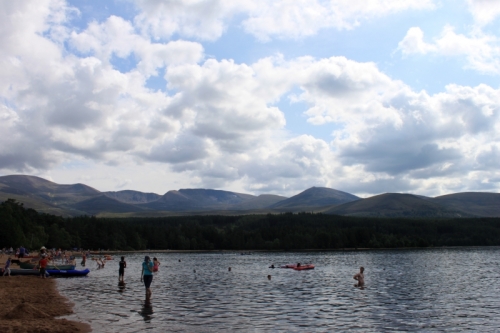
Being located in the Queen's Forest of Glenmore Forest Park the loch is surrounded by spectacular woodland and many visitors enjoy the walking route around the loch. Owned by the Forestry Commission the park contains one of the few remaining pockets of ancient Caledonian Pinewood in Scotland. Ongoing work is being undertaken to safeguard and develop this essential habitat for future generations. We walked a section of the 6km trail but didn't complete the whole circuit because we decided that we wanted to take a canoe out onto the loch as it was so calm and peaceful. 
After a delicious picnic lunch in glorious sunshine we headed off to hire our canoe. What a wonderful experience paddling on the loch and enjoying the spectacular panoramic views in this magnificent setting. What better way to spend an afternoon. Watersports enthusiasts of all levels can choose from a variety of activities including windsurfing, kayaking, sailing and canoeing with the security of having access to expert tuition. The Boathouse also serves tasty food and homebaking from the cafe which has a million dollar view down the loch. 
I topped off my busy day with a cycling excursion in Monarch of the Glen country and a game of tennis......Phew  ! !
|
|
|


)